
The History of Belmont Park, Why It Matters, and What the Future Holds
What Belmont Park Is and Why Racing Fans Care
Belmont Park sits in Elmont, New York, right on the Queens and Nassau County line, and it has carried more weight in American thoroughbred racing than almost any other track in the country. It is the home of the Belmont Stakes, the third and final leg of the Triple Crown, and the track that has staged the sport's biggest moments for well over a century. Every serious handicapper knows the nickname Big Sandy, the mile and a half main track that has tested champions since 1905. Understanding where Belmont Park came from, what it has been through, and where it is headed helps explain why a single afternoon of racing there still carries so much weight with bettors and fans alike.
The Founding of Belmont Park in 1905
Belmont Park opened its gates on May 4, 1905, the product of a syndicate led by August Belmont II and former Secretary of the Navy William C. Whitney. The pair wanted to build the most elaborate track in America, modeled on the grand racecourses of Europe, and they picked a 650 acre parcel known as Foster's Meadow that straddled the Queens and Nassau border on Long Island. More than 40,000 spectators turned out for opening day. On the undercard, August Belmont II's own horse, Blandy, won the 1,500 dollar Belmont Inaugural at 7 to 1, holding off a 100 to 1 shot named Oliver Cromwell.
The feature race that day is still talked about by racing historians. The Metropolitan Handicap, a one mile race that remains one of the sport's oldest and most prestigious stakes, drew a thirteen horse field that included Sysonby, later ranked among the top 30 American horses of the twentieth century by Blood Horse magazine, making his 3 year old debut against the champion mare Beldame. In the stretch, Sysonby ran into an unexpected challenge from 20 to 1 outsider Race King, and the two of them hit the wire together in a dead heat. Beldame was in that field but did not factor into the finish. Belmont Park was a statement track from its very first day, and it has never really stopped being one.
Belmont Park and the Triple Crown
The Belmont Stakes itself is older than the track that now hosts it. The race dates back to 1867, run first at Jerome Park and later at Morris Park before it found its permanent home at Belmont Park in 1905. At a mile and a half, it is the longest of the three Triple Crown races and has earned the nickname the Test of the Champion, because a horse that has already survived the Kentucky Derby and the Preakness Stakes still has to prove it can carry that speed over a distance American racing rarely asks for anymore.
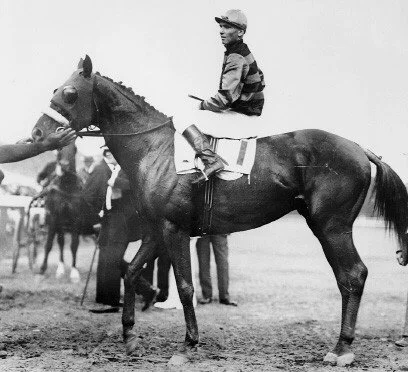
The legendary Sir Barton was the first horse to win the Triple Crown.
Only thirteen horses have completed the sweep since Sir Barton became the first in 1919, and Belmont Park is where each of them sealed it. Gallant Fox did it in 1930, Omaha in 1935, War Admiral in 1937, Whirlaway in 1941, Count Fleet in 1943, Assault in 1946 and Citation in 1948. Then came a 25 year gap before Secretariat produced the performance the sport still measures everything against, a 31 length demolition in 1973 that remains the fastest mile and a half ever run on dirt. Seattle Slew followed in 1977, Affirmed edged Alydar in one of the greatest rivalries in racing history in 1978, and after a 37 year drought American Pharoah finally broke through in 2015 with Justify completing the set again in 2018. Every one of those horses made history at Belmont Park specifically, not just in the Triple Crown in the abstract.
Decades of Change: Closures, Rebuilds, and Modern Racing
Belmont Park has not stood still since 1905. The original grandstand closed in 1963 after engineers found structural defects that made it unsafe, and the track did not reopen until 1968 with a new grandstand in place. Belmont went on to host the Breeders' Cup World Championships twice, in 2001 and again in 2005, cementing its status as one of the handful of American tracks capable of running the sport's showcase event.
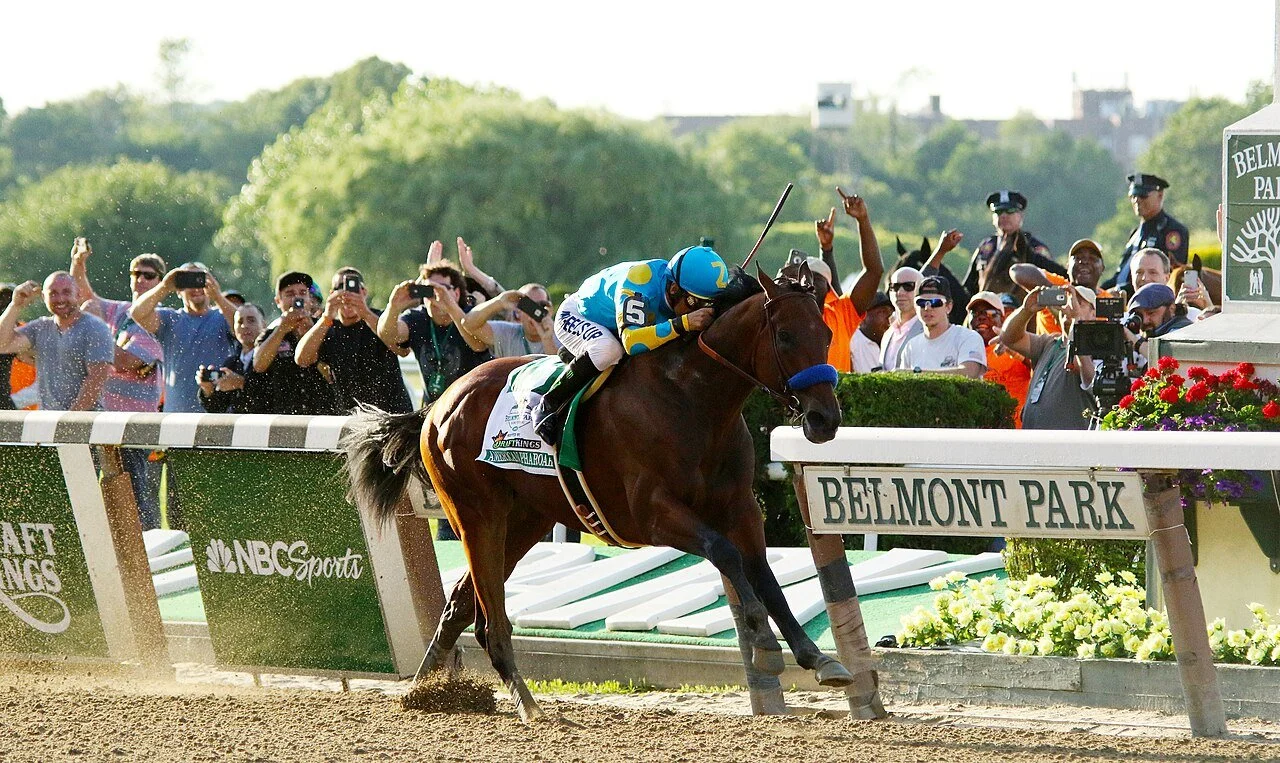
American Pharoah crossing the line in 2015 to end a 37 year Triple Crown drought, a defining chapter in Belmont Park history. Photo by Mike Lizzi, licensed CC BY SA 2.0.
A modernization push between 2012 and 2015 brought hundreds of HD televisions and video boards onto the property along with Trakus tracking technology and a 5 million dollar overhaul of the Long Island Rail Road transit rotunda that let trains carry ten cars instead of the previous limit. Then came the biggest change in the track's history. Belmont Park's last live race meet ran in 2023, and its last true fall meet was all the way back in 2021, before NYRA closed the property entirely to begin the full demolition and rebuild that produced the track reopening this September. The Belmont Stakes itself moved north to Saratoga Race Course for three straight runnings in 2024, 2025 and 2026 while construction went on. That relocation, unthinkable in normal circumstances, showed just how far NYRA was willing to go to get the new Belmont right rather than rush it.
Why Aqueduct's Closure Changed Everything
None of this makes sense without Aqueduct. Aqueduct Racetrack, long known simply as the Big A, ran its final card on June 28, 2026, closing for good after 132 years as New York City's racetrack. NYRA folded Aqueduct into Belmont on purpose, not as an afterthought. Downstate New York racing had run as two separate tracks for generations, and NYRA is now running it as one operation out of Elmont.
That single decision explains why the new Belmont Park looks the way it does. The Tapeta all weather track exists specifically to take over the job Aqueduct used to do, keeping racing going through the winter months when a dirt track freezes and turf courses shut down for the season. NYRA has been explicit that the expanded Belmont fall meet is a direct result of what it calls the consolidation of its downstate racing operations at Belmont, and that consolidation is arguably the single most consequential change in the track's modern history, bigger in practical terms than the grandstand itself.
Why Belmont Park Matters to American Racing
Belmont Park is not just another stop on the calendar. It is the track where the sport's biggest legends proved themselves, from Secretariat's still unmatched Belmont Stakes record to Man o' War's dominance in the 1920s. Big Sandy, the main dirt oval, has long been recognized as one of the widest and most demanding tracks in North America, a true test of stamina that separates good horses from great ones.
Belmont's location just outside New York City puts it in front of the largest media market in the country every time NYRA and FOX put a broadcast together, which matters for the sport's visibility as much as any single race does. With Aqueduct now closed, Belmont also carries the full weight of downstate training and stabling that used to be split across two properties, tying it and Saratoga together as one NYRA operation instead of two. When Belmont Park succeeds, New York racing succeeds, and that ripple effect reaches every bettor following the sport nationally.
The $455 Million Rebuild: What’s New at Belmont Park
The new Belmont Park is not a renovation of the old grandstand, it is a ground up rebuild funded by roughly 455 million dollars in public loan funding authorized through the 2024 fiscal year. Glen Kozak, NYRA's senior vice president of operations and capital projects, has described the demolition and site prep as running close to complete ahead of construction, with crews pouring concrete and building out the first floor deck through 2025 and into 2026.
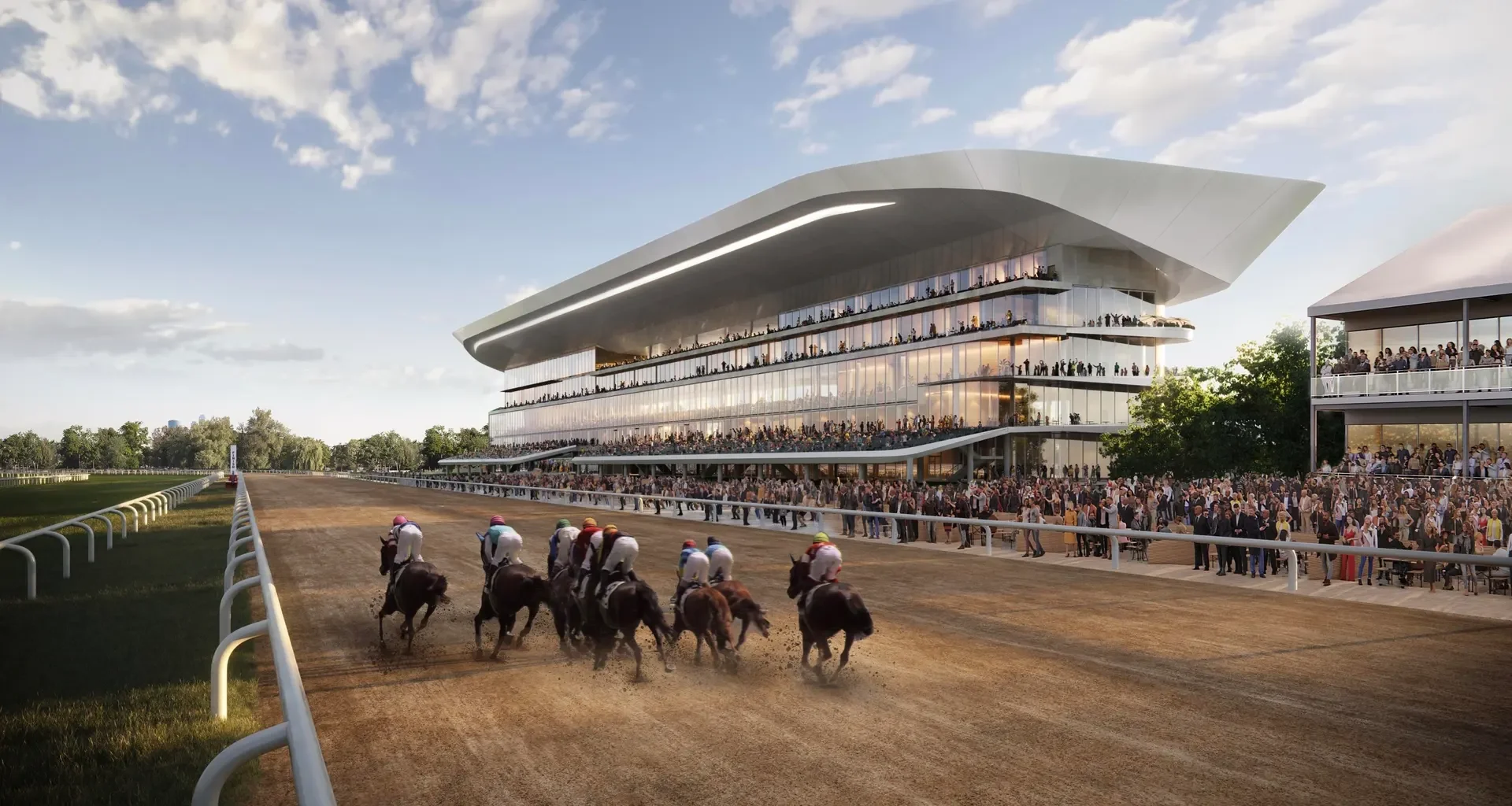
The finished facility replaces the 1968 grandstand with a five story building designed around modern sightlines, with Champion Suites, multi day hospitality packages, climate controlled lounges and expanded food and beverage concourses alongside more traditional open air terraces for fans who want the old school Belmont feel. On the racing surface side, the track now runs four distinct configurations: the historic mile and a half main dirt oval, two turf courses, and a brand new one mile Tapeta all weather track built specifically to keep racing going through the winter months when dirt and turf are not an option.
Roughly 20 acres of infield green space have also opened up to fans and the surrounding Elmont community, a genuine shift from the old model where that space sat largely unused on non race days. The plan calls for a soft opening with the first two floors ready this fall, with the remaining floors, suites and banquet spaces coming online in spring 2027.
Opening Day 2026 and the Fall Meet
Belmont Park's new era begins on September 18, 2026, and NYRA gave the reopening the kind of headline race it deserves. The Grade 1 Jockey Club Gold Cup, a race with roots stretching back to 1919 and a 1 million dollar purse, anchors opening day and carries Win and You're In status for the Breeders' Cup Classic, guaranteeing the winner a start in racing's championship event. The race had been run at Saratoga every year from 2021 through 2025, so its return to Belmont is part of what makes this particular opening day significant. Forever Young heads the field and the race is live on FOX at 4:14pm ET, putting the new facility in front of a national audience from its very first afternoon.
Demand for opening day has been strong enough that NYRA capped attendance at a sold out 6,000, and there are no tickets available at the gate, so anyone planning to be there in person needed to buy in advance. Andrew Offerman, NYRA's senior vice president of racing and operations, put it simply when he said the new Belmont Park will provide the stage to showcase the best racing in North America.
The fall meet that follows runs 46 live race days through December 6, 2026, with 72 stakes races worth a combined 17.7 million dollars in purses and seven Breeders' Cup Win and You're In races built into the schedule. Once the fall meet wraps, Belmont keeps racing straight through the winter on the new Tapeta all weather track, with that winter meet opening December 10, the entire reason NYRA built that surface in the first place.
What the Future Holds for Belmont Park
The rebuild was always about more than one opening weekend. The Belmont Stakes itself returns to its traditional Long Island home in 2027 after three years at Saratoga, putting the Test of the Champion back on the track it was built for. That same year, Belmont Park hosts the Breeders' Cup World Championships, the first time the event has come to New York since Belmont's own 2005 edition.
Construction keeps moving through that window too, with the remaining grandstand floors, premium suites and banquet facilities scheduled to open in full by spring 2027, ahead of both marquee events. Put together, 2027 is shaping up to be the year the new Belmont Park stops being a work in progress and becomes what NYRA set out to build, a modern home for the sport's oldest traditions.
How to Bet Belmont Park Racing in Connecticut
Every race on the new Belmont Park card, from an opening day maiden race to the Jockey Club Gold Cup itself, is available to bet through MyWinners. We carry full pari mutuel wagering on the entire Belmont Park card, including win, place, show and every exotic bet type NYRA offers, so Connecticut bettors get the same menu a fan standing at the rail in Elmont gets.
You can bet Belmont Park racing two ways with us. Online betting through MyWinners is open to all customers 18 and older, not just Connecticut residents, so out of state family and friends can bet right alongside you. If you would rather bet in person, every MyWinners and Winners venue across Connecticut takes Belmont Park wagers on simulcast, with the same fields, odds and pools you would find betting online.
Download the MyWinners Racing and Sports app on iOS or Android to bet from your phone before first post, or set up your account at app.mywinners.com if you prefer to bet from a desktop. Either way, once the new Belmont Park gates open on September 18, we will have the full card up and ready to bet from the very first race.
How We Follow Belmont Park Racing at MyWinners
Belmont Park's reopening gives us a full slate of stakes racing to track through the rest of 2026, and we will be covering the fall meet card by card as the new track finds its rhythm.
Bet online at app.mywinners.com, on the MyWinners: Racing & Sports app on iOS or Android, or go here to find your nearest MyWinners or Winners venue in CT.
Frequently Asked Questions
Belmont Park opened on May 4, 1905 in Elmont, New York. A syndicate led by August Belmont II and William C. Whitney built the track on a 650 acre site straddling the Queens and Nassau County border, and more than 40,000 people attended opening day.
Belmont Park hosts the Belmont Stakes, the third and final leg of the Triple Crown and the longest of the three races at a mile and a half. All thirteen Triple Crown winners since Sir Barton in 1919, including Secretariat, Seattle Slew, Affirmed, American Pharoah and Justify, sealed their sweep at Belmont Park.
NYRA closed the old Belmont Park in 2024 for a full demolition and rebuild costing roughly 455 million dollars. The Belmont Stakes moved to Saratoga Race Course for the 2024, 2025 and 2026 runnings while construction was underway, and the new facility opened for racing on September 18, 2026.
The new Belmont Park has a five story grandstand, Champion Suites, climate controlled lounges and expanded food and beverage areas. On the track side there are now four racing surfaces: the historic mile and a half dirt oval, two turf courses, and a new one mile Tapeta all weather track for winter racing, plus about 20 acres of new infield green space for fans.
The Belmont Stakes returns to its traditional Long Island home in 2027 after three years at Saratoga. That same year, Belmont Park is also scheduled to host the Breeders' Cup World Championships, the first time the event has come to New York since 2005.
