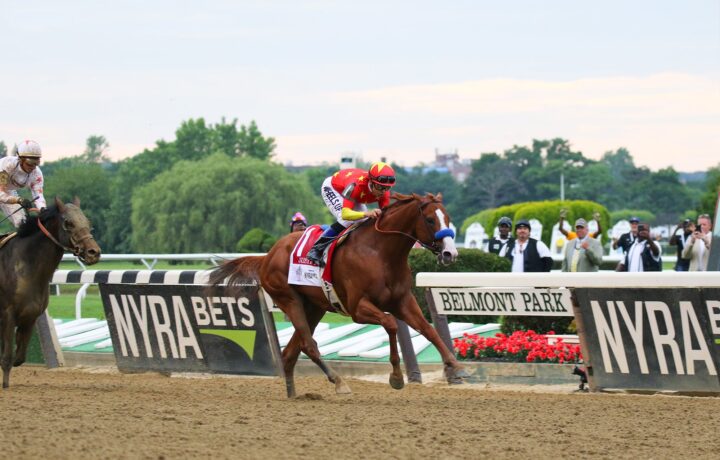
The Belmont Park Tapeta takes over New York’s winter racing on Thursday, December 10. For bettors, this represents the biggest change to the NYRA calendar in a generation. Aqueduct closed for good on June 28, so the rebuilt Belmont now carries the whole downstate program. As a result, every winter race will run over the new one-mile synthetic oval.
We think that makes Belmont one of the most interesting winter betting circuits in the country. So here’s why, from the money behind it to the first results and the stakes heading to the surface.
A $555 Million Bet on Year-Round Racing at Belmont Park
The New York Racing Association reopened Belmont Park on September 18 after a three-year rebuild. The project cost $555 million, backed by a $455 million state loan, according to Governor Kathy Hochul’s office. As part of that work, NYRA built four new surfaces: a 1 1/2-mile dirt track, two turf courses and a one-mile Tapeta oval.
Still, that Tapeta oval is the one that matters from December to March. The state says the new tracks allow year-round racing at Belmont for the first time ever. In short, the Belmont Park Tapeta is the reason Long Island can race through the winter at all.
NYRA is also putting real money into the product. Overnight purses for the winter meet rise 23% to more than $26 million, and the average overnight purse climbs nearly 10%, per NYRA’s purse announcement. On top of that, the Big Apple Bonus pays up to $8,500 per horse that ships or relocates to Belmont from another circuit. After all, bigger purses pull in more horses, and more horses make better betting races.
How the Belmont Park Tapeta Passed Its First Test
The surface made its race debut sooner than planned. On Sunday, September 20, the third day of racing at the new track, heavy rain moved four races off the turf and onto the Tapeta. BloodHorse reported fields of 8, 12, 12 and 9 in those races, an average of 10.25 runners. By contrast, a switch to the muddy main track would likely have cut those fields in half.
The results looked fair, too. Two of the four winners went off at 5/2 or shorter, so the market read the races well. Meanwhile, the winners sat third, first, ninth and fourth after the opening quarter mile. In other words, the track didn’t simply hand races to the early leader. That’s a good start.
Trainer Miguel Clement saddled four runners that afternoon and won the last Tapeta race with Lyn’s Legacy, a daughter of Medaglia d’Oro whose two previous starts came on turf. He also ran second by a head with the New York-bred juvenile Fierce Hope, who closed from 10th of 12. Clement told BloodHorse he would likely have scratched three of his four if those races had stayed on the main track. His one gripe was more kickback than expected, although his horses ran through it.
Bigger Fields Make Better Bets
Field size drives everything we like about a betting race. After all, a seven-horse field with an odds-on favorite gives us little to work with. By contrast, ten or eleven runners open up value in the win pool and turn the exacta, trifecta and multi-race bets into puzzles worth solving.
Winter racing in New York has struggled on this front for years. Paulick Report columnist Carter Wilkie noted that Aqueduct’s winter meet averaged fewer than seven betting interests per race. Top barns headed to Florida, while turf horses had nowhere to run once the grass courses closed.
However, the Belmont Park Tapeta changes that equation. Turf runners can handle a synthetic surface far more comfortably than a cold, sloppy dirt track, as Lyn’s Legacy showed in September. Woodbine stables know it well. In fact, Wilkie reported that Canadian trainer Kevin Attard aims to bring 25 to 30 horses to New York if he can. Mark Casse, who has made more than 10,000 starts on synthetic tracks, told Wilkie he will keep horses up north year round, something his stable hasn’t done in as long as he can remember.
Fewer Cancellations When the Weather Turns
Snow and hard frost wipe out winter cards across the East. Last January, snow and bitter cold forced cancellations as far south as Oaklawn Park in Arkansas. A frozen dirt track can’t race safely, and a sealed, sloppy one shrinks fields as trainers scratch.
The Belmont Park Tapeta, however, behaves differently. The surface blends silica sand, polymer fibers and wax, so water drains through rather than sitting on top. Paulick Report says it can absorb up to two inches of snow when crews harrow it in promptly. Crews still have to blade off anything deeper than four inches, so no track is weatherproof.
Even so, fewer lost days mean fewer scrapped Pick 4s and steadier form lines from week to week. The real test is still ahead. Cold weather is the exam. Clement called winter conditions the big question, and NYRA had about three months after the September debut to fine tune the surface. December 10 is when we find out.
Winter Stakes on the Belmont Park Tapeta
NYRA has carded 28 stakes worth nearly $5.7 million for the winter meet, and every one runs on the Tapeta, per the official winter stakes schedule. Even so, several familiar races look very different this year. For example, the Red Smith (G2) switches from 1 3/8 miles on turf to 1 3/16 miles on the synthetic and moves to December 26. Meanwhile, the Suburban (G2) leaves its summer slot for February 20 at nine furlongs.
Below, our table picks out the headline races, including the Kentucky Derby and Oaks points events.
| Date | Race | Grade | Purse | Distance | Why It Matters |
|---|---|---|---|---|---|
| Dec 26 | Red Smith | G2 | $250,000 | 1 3/16 miles | Switches from turf, so expect new faces |
| Jan 16 | Withers | Listed | $175,000 | 1 1/16 miles | First Derby points race on the surface |
| Jan 16 | Busanda | Ungraded | $150,000 | 1 1/16 miles | Also awards Kentucky Oaks points |
| Jan 23 | Long Island Derby | Ungraded | $300,000 | 9 furlongs | Part of the Empire Trillium Series |
| Feb 20 | Suburban | G2 | $500,000 | 9 furlongs | Leaves its summer slot for February |
| Feb 20 | Gotham | G3 | $400,000 | 9 furlongs | Worth 50 Derby points after a $100,000 raise |
| Feb 20 | Busher | Listed | $175,000 | 1 1/16 miles | Oaks prep that also offers 50 points |
| Feb 20 | Tom Fool | G3 | $200,000 | 6 furlongs | Graded sprint on the same Gotham Day card |
Source: NYRA 2026/27 Belmont Park winter meet stakes schedule. All races run on the Belmont Park Tapeta. NYRA may still change purses and dates, so check the card before you bet.
Kentucky Derby Points on a Synthetic Surface
Now the Derby trail runs over the Tapeta as well. First up, the Withers on January 16 offers 20 points to the winner at 1 1/16 miles. Then the Gotham (G3) on February 20 jumps to $400,000 and nine furlongs, with 50 points for the winner. The Busanda and Busher do the same job for Kentucky Oaks hopefuls, while the Wood Memorial (G2) stays on dirt.
So handicappers get a new puzzle each spring. A Gotham winner on Tapeta still has to prove himself on dirt at Churchill Downs. For that reason, we will track how the synthetic preps translate, because the early answers could shape value in the Derby futures.
A New Dimension for American Racing
Synthetic racing is nothing new in North America, but it has never had a stage like New York. Tapeta already runs at Woodbine, Turfway Park, Gulfstream Park and Presque Isle Downs. California, by contrast, went the other way and dropped synthetics at Santa Anita in 2010 and Del Mar in 2015. New York now takes the opposite view.
Belmont’s move puts an all-weather surface at one of the sport’s flagship venues. It also ties New York closer to Woodbine. The two circuits share the 14-race Empire Trillium Series, worth $3.2 million, for horses foaled in New York or Canada, and eight of those races run at Belmont this winter.
For bettors, that also means more crossover between two circuits that already trade horses. Woodbine form on Tapeta now carries straight into New York, so we get a deeper pool of comparable races to handicap.
Our Angles for Betting the Tapeta
Early form on the Belmont Park Tapeta is thin, so we will lean on a few angles until the data builds. First, turf form travels. Lyn’s Legacy won first time on the surface after two turf starts, and we will give turf runners extra credit in the early weeks.
Next, don’t assume speed holds. Flavien Prat felt the surface played a touch speed favoring in the first race. Later that day he won the juvenile maiden from ninth on Soldier’s Glory, a first-time starter for Jena Antonucci, holding off Fierce Hope by a head.
Shippers from Woodbine and Turfway deserve respect too, since they arrive with proven form on similar surfaces. Finally, watch the kickback. Clement and jockey Manny Franco both mentioned more than expected, so horses that dislike dirt in their faces may not take to it straight away.
Bet Belmont Park Winter Racing With MyWinners
Belmont’s winter meet opens Thursday, December 10, and the first winter stakes, the Say Florida Sandy and the Broadway, run on December 19. After that, the Red Smith headlines a five-stakes card on December 26. NYRA racing is open to all MyWinners customers 18+, so the whole Tapeta season is there to bet. If the jargon is new to you, our guide to horse racing terms covers the basics.
Bet online at app.mywinners.com, on the MyWinners: Racing & Sports app on iOS or Android, or go here to find your nearest MyWinners or Winners venue in CT.
Image © The New York Racing Association, Inc.