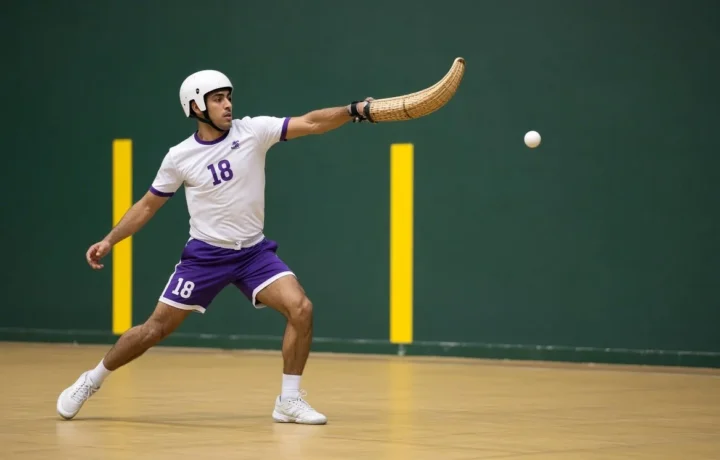

Jai alai looks like chaos the first time you see it. A rock hard ball cracks off a granite wall, players sprint the length of a court twice the size of a basketball floor, and the scoreboard changes every few seconds. Learn the jai alai rules and the whole thing clicks. The format is simple, the scoring has a clever twist, and every game produces a clear win, place and show finish for betting.
This guide covers the court, the equipment, the serve, how points are won and lost, and the Spectacular Seven scoring system used at American frontons. If you are new to the sport, our jai alai explainer covers the history and the betting appeal, and this post fills in the detail.
The Basics of Jai Alai
Jai alai comes from the Basque Country, which straddles northern Spain and southwest France. In Spain the wider family of games goes by the name pelota vasca, and the name jai alai comes from a Basque phrase usually translated as “merry festival.” Players catch and throw a ball called the pelota using a long, curved wicker basket called the cesta, strapped to the arm.
Speed defines the sport. José Ramón Areitio holds the jai alai record with a throw of 188 mph at Newport Jai Alai in Rhode Island, according to the jai alai entry on Wikipedia. At those speeds, every one of the jai alai rules exists to keep play fair and readable for players, judges and bettors alike.
The Jai Alai Court
The court, known as the cancha, runs about 176 feet long and 40 feet wide. It has three walls: front, back and left. The right side stays open so fans can watch, and a strip of out of bounds floor called the contracancha runs 10 to 15 feet along that side. The front wall is granite.
Fourteen parallel lines cross the floor. Line 1 sits nearest the front wall and line 14 sits nearest the back. Those numbers matter because the serve rules reference them directly. Red areas mark out of bounds zones, and the lowest 3 feet of the front wall also counts as out.
| Rule | Detail |
|---|---|
| Court length | About 176 feet |
| Court width | About 40 feet |
| Walls | Front (granite), back and left. Right side open to spectators |
| Floor lines | 14, numbered from the front wall (line 1) to the back (line 14) |
| Serve | Bounce behind line 11, then throw at the front wall |
| Legal serve zone | Ball must land between lines 4 and 7 |
| Catching | On the fly or after one bounce |
| Throwing | One fluid motion. No holding or juggling |
| Throwing hand | Right hand only |
| Entries per game | 8 posts, singles or doubles |
| Points per rally | 1 in the first round, 2 once every post has played |
| Winning score | 7 (Spectacular Seven) or 9 (Spectacular Nine) |
| Ties | Decided by a playoff |
Why Jai Alai Rules Require Right Handed Play
The only side wall stands on the left. A left handed throw would put spin on the ball that favors left handed players, so every player throws right handed, natural lefties included. That one quirk explains why you never see a cesta on a player’s left arm.
Jai Alai Equipment: The Pelota and the Cesta
The pelota measures roughly three quarters the size of a baseball. Makers hand wind a core of rubber, then wrap it in two layers of goatskin. Wall impacts wear the covers out fast, so balls need a new cover about every 15 minutes of play.
The cesta is a hand woven reed basket about 2 feet long, custom made for each player. Its curve lets players whip huge spin onto the pelota, and that spin makes returns so hard to read.
Jai Alai Rules for the Serve
Every point starts with a serve. The server bounces the pelota behind the serve line, which is line 11, and hurls it at the front wall. On the rebound, the ball has to land between lines 4 and 7. A serve that falls short of line 4 or carries past line 7 counts as an underserve or an overserve, and the receiving side takes the point.
Once a legal serve lands in that zone, the rally is live. The receiver can catch it on the fly or after its first bounce.
How Points Are Won and Lost
The core of the jai alai rules comes down to the catch. A player must catch the pelota on the fly or after one bounce, then send it back to the front wall. A second bounce ends the point.
The catch and the throw have to happen in one fluid motion. Players cannot hold the ball, pause with it, or juggle it in the cesta. Judges watch every exchange and enforce the jai alai rules on those faults.
A side loses the point when it serves short or long, misses the catch, holds or juggles the ball, or throws it out of bounds. Interference also costs points when a player blocks an opponent’s path to a playable ball, and that call rests with the judges.
The Chula Shot
Every fan learns the chula early. A player fires the pelota off the front wall so it comes back low off the back wall with little or no bounce, almost rolling along the floor. The opponent has almost nothing to catch, and the chula ranks among the toughest shots in the game to return.
Singles and Doubles
American jai alai usually features eight entries per game, either eight single players or eight teams of two. Teams of three show up only rarely. The jai alai rules for the serve and the catch stay the same in both formats. In doubles, each team pairs a frontcourt player with a backcourt player, and both cover the same right handed catching rules.
Spectacular Seven: How Jai Alai Scoring Works
Here the jai alai rules part ways with tennis or squash. Each game runs as a round robin. All eight entries get a post position from 1 to 8, and two posts take the court for each point. The winner stays on and faces the next post in line. The loser goes to the back of the line.
In the first round, every point counts for one. Once every post has played at least one point, each point doubles to two. The first entry to reach 7 wins the game. That format goes by the name Spectacular Seven. Some games, typically superfecta games, run to 9 points instead, a format called Spectacular Nine.
The doubling changes the math. A post at the back of the line can sit out most of round one and still reach 7 with a short winning streak once points are worth two.
Jai Alai Scoring Example
Here is how a Spectacular Seven game can play out. Post 1 beats post 2, then beats post 3. Post 4 knocks out post 1 and beats post 5. Post 6 beats post 4 and post 7. Post 8 then beats post 6 on the seventh point, and with that every post has played. From point 8 onward, every point is worth two.
Post 8 stays on court and beats post 2, post 3 and post 1 in turn. That adds six points to the one it already had, so post 8 wins with 7, despite starting last in line. Posts 1, 4 and 6 all finish on 2, so a playoff decides place and show.
| Point | Matchup | Winner | Points Awarded | Winner's Total |
|---|---|---|---|---|
| 1 | Post 1 vs Post 2 | Post 1 | 1 | Post 1: 1 |
| 2 | Post 1 vs Post 3 | Post 1 | 1 | Post 1: 2 |
| 3 | Post 1 vs Post 4 | Post 4 | 1 | Post 4: 1 |
| 4 | Post 4 vs Post 5 | Post 4 | 1 | Post 4: 2 |
| 5 | Post 4 vs Post 6 | Post 6 | 1 | Post 6: 1 |
| 6 | Post 6 vs Post 7 | Post 6 | 1 | Post 6: 2 |
| 7 | Post 6 vs Post 8 | Post 8 | 1 | Post 8: 1 |
| 8 | Post 8 vs Post 2 | Post 8 | 2 | Post 8: 3 |
| 9 | Post 8 vs Post 3 | Post 8 | 2 | Post 8: 5 |
| 10 | Post 8 vs Post 1 | Post 8 | 2 | Post 8: 7 (wins) |
Win, Place, Show and Ties
Final standings under the jai alai rules settle every bet. The entry that reaches 7 first (or 9 in a Spectacular Nine game) wins. The next highest scorer takes place, and the third highest takes show. When entries finish level, a playoff sorts out the order, which matters to anyone holding a place, show, quiniela or trifecta ticket.
Jai alai runs on parimutuel betting, so every bet of the same type goes into one pool and the payout depends on how much that pool holds. Our jai alai betting guide breaks down each bet type.
Jai Alai in Connecticut
Connecticut once ranked among the biggest jai alai states in the country. Hartford Jai Alai opened in 1976 and closed in 1995. Bridgeport also opened in 1976 and ended jai alai in 1995. Milford opened in May 1977 and lasted until 2001. An amateur fronton opened in Berlin in 2010, though it runs no betting or organized leagues.
Bet on Jai Alai With MyWinners
Now you know the jai alai rules, from the serve zone between lines 4 and 7 to the doubled points of Spectacular Seven. That knowledge pays off when you read a program, follow a game point by point, and judge which posts have a real chance at place and show. MyWinners offers parimutuel betting on jai alai, so you can put it to work.
Connecticitu residents can bet online at app.mywinners.com, on the MyWinners: Racing & Sports app on iOS or Android, or go here to find your nearest MyWinners or Winners venue in CT.