Understanding how to read betting odds is not always easy. Betting odds come in several formats, and you’ll run into most of them at MyWinners. Horse racing prices show as fractions, like 5/2 or 9/4. The Fanatics Sportsbook boards at Winners venues show American odds, like -150 or +200. International racing sites and betting exchanges use decimals, like 3.50. Every one of these formats describes the same thing in a different language.
This guide teaches you to read all of them. We cover fractional odds and how they work on a US tote board, the difference between the morning line and live odds, American moneylines, decimal odds and the Asian formats. We also show you how to turn any price into a payout and a percentage, how the bookmaker’s margin and the track’s takeout work, and where each format came from.
Every Odds Format Tells You the Same Three Things
Whatever format you’re looking at, the price answers three questions. Who’s the favorite? How much do you win? How often does the bet need to land for you to break even?
Take a horse with a 40% chance of winning a race. In fractional odds, that’s 3/2. In American odds, it’s +150. In decimal, it’s 2.50. A $100 bet on that horse returns $150 profit in every format, and $250 back in total once your stake comes back. The numbers look different. The bet stays the same.
The table below shows a favorite and an underdog written out in every major format.
| Format | Where You'll See It | Favorite (60%) | Underdog (33.3%) | What the Number Shows |
|---|---|---|---|---|
| Fractional | Horse racing on MyWinners and US tote boards, UK and Irish bookmakers | 4/6 | 2/1 | Profit per unit staked |
| American | US sportsbooks, including Fanatics at Winners venues | -150 | +200 | Stake needed to win $100, or profit on a $100 bet |
| Decimal | Europe, Australia, New Zealand, betting exchanges | 1.67 | 3.00 | Total return per unit, stake included |
| Hong Kong | Hong Kong | 0.67 | 2.00 | Profit per unit staked |
| Malay | Malaysia | 0.67 | -0.50 | Profit per unit up to evens; stake to win one unit beyond it |
| Indonesian | Indonesia | -1.50 | +2.00 | American odds divided by 100 |
Betting Odds Formats at a Glance
Fractional Odds: The Language of Horse Racing
Fractional odds are the oldest betting format still in everyday use, and they’re the standard for horse racing on both sides of the Atlantic. MyWinners shows every racing price as a fraction, whether the race runs at Saratoga or Ascot.
How to Read Fractional Odds
The number on the right is your stake. The number on the left is your profit. At 5/1, you win $5 for every $1 you bet. At 9/4, you win $9 for every $4 you bet. A $10 bet at 9/4 wins $22.50, and your $10 stake comes back too, for $32.50 in total.
The fastest way to work out any fractional price is to divide the left number by the right number, then multiply by your stake. 7/2 works out to 3.5, so a $20 bet wins $70.
Odds On, Evens and Odds Against
When the left number is bigger than the right, the horse is odds against. You win more than you stake. A 4/1 shot falls into this group, and so do most horses in most races.
When the two numbers match, the price is evens, also written 1/1. You win exactly what you stake.
When the left number is smaller than the right, the horse is odds on. You win less than you stake. A 1/2 favorite pays $1 profit for every $2 bet. UK bookmakers often say an odds on price the other way round, so you’ll hear 4/6 called “six to four on.”
Common Fractional Prices and What They Mean
UK and Irish bookmakers use a traditional ladder of prices that includes some odd looking fractions, like 11/8, 15/8 and 100/30. Each one sits between its neighbors in value. 100/30 pays slightly more than 3/1 and slightly less than 7/2. The table below converts the most common fractional prices into decimal, American and implied probability.
| Fractional Odds | Decimal Odds | American Odds | Implied Probability |
|---|---|---|---|
| 1/5 | 1.20 | -500 | 83.3% |
| 1/4 | 1.25 | -400 | 80.0% |
| 1/3 | 1.33 | -300 | 75.0% |
| 2/5 | 1.40 | -250 | 71.4% |
| 1/2 | 1.50 | -200 | 66.7% |
| 4/6 | 1.67 | -150 | 60.0% |
| 4/5 | 1.80 | -125 | 55.6% |
| 10/11 | 1.91 | -110 | 52.4% |
| Evens (1/1) | 2.00 | +100 | 50.0% |
| 11/10 | 2.10 | +110 | 47.6% |
| 6/5 | 2.20 | +120 | 45.5% |
| 5/4 | 2.25 | +125 | 44.4% |
| 11/8 | 2.38 | +138 | 42.1% |
| 6/4 | 2.50 | +150 | 40.0% |
| 13/8 | 2.63 | +162 | 38.1% |
| 7/4 | 2.75 | +175 | 36.4% |
| 15/8 | 2.88 | +188 | 34.8% |
| 2/1 | 3.00 | +200 | 33.3% |
| 9/4 | 3.25 | +225 | 30.8% |
| 5/2 | 3.50 | +250 | 28.6% |
| 11/4 | 3.75 | +275 | 26.7% |
| 3/1 | 4.00 | +300 | 25.0% |
| 100/30 | 4.33 | +333 | 23.1% |
| 7/2 | 4.50 | +350 | 22.2% |
| 4/1 | 5.00 | +400 | 20.0% |
| 9/2 | 5.50 | +450 | 18.2% |
| 5/1 | 6.00 | +500 | 16.7% |
| 6/1 | 7.00 | +600 | 14.3% |
| 7/1 | 8.00 | +700 | 12.5% |
| 8/1 | 9.00 | +800 | 11.1% |
| 10/1 | 11.00 | +1000 | 9.1% |
| 12/1 | 13.00 | +1200 | 7.7% |
| 16/1 | 17.00 | +1600 | 5.9% |
| 20/1 | 21.00 | +2000 | 4.8% |
| 25/1 | 26.00 | +2500 | 3.8% |
| 33/1 | 34.00 | +3300 | 2.9% |
| 50/1 | 51.00 | +5000 | 2.0% |
| 100/1 | 101.00 | +10000 | 1.0% |
Fractional Odds Conversion Chart: Decimal, American and Implied Probability
Tote Odds: How US Horse Racing Prices Work
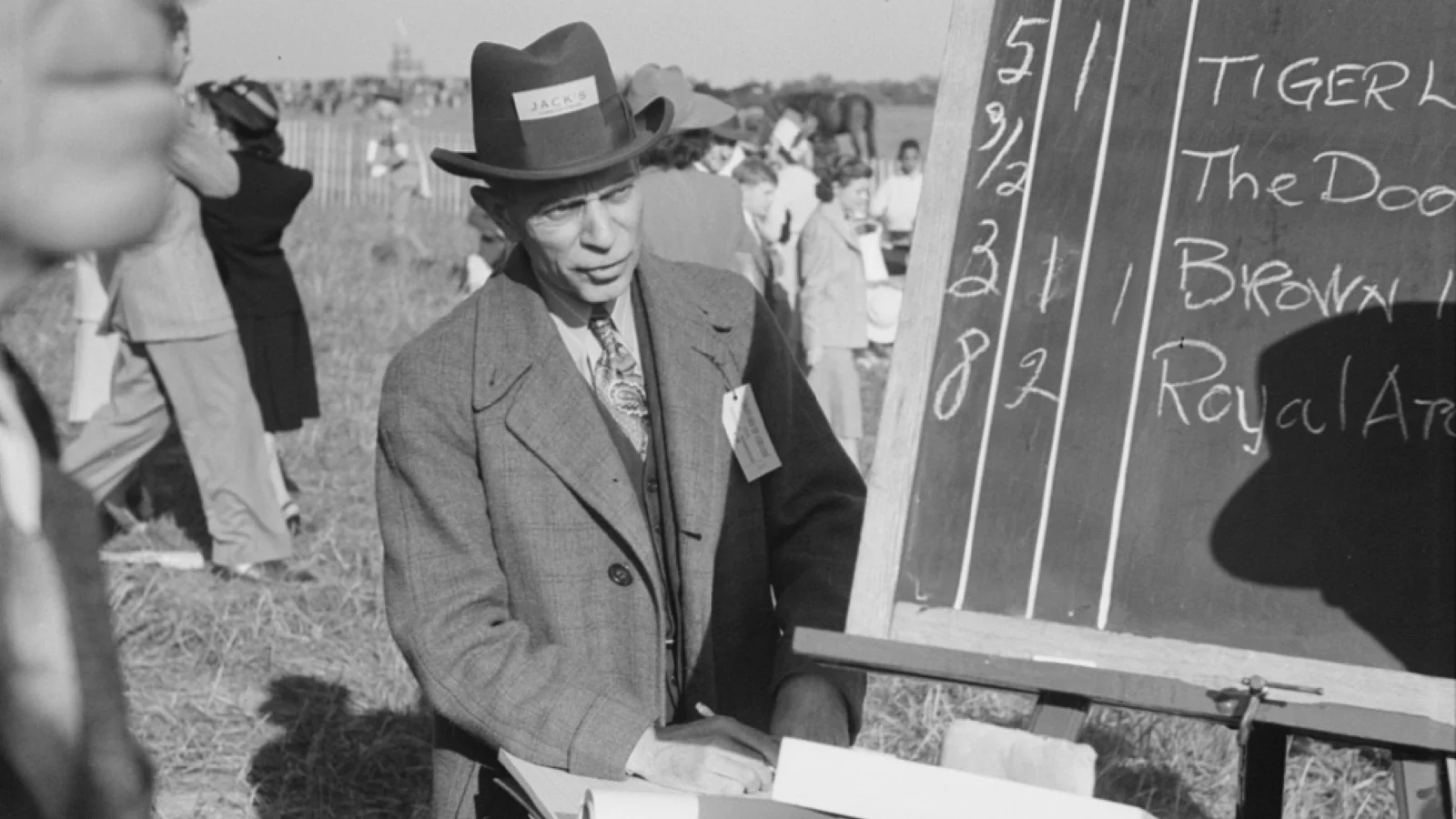
US horse racing runs on parimutuel pools rather than fixed odds. Bettors bet against each other, not against a bookmaker, and the tote board shows the current price on every horse as a fraction.
How the Tote Board Works
Every bet on a race goes into a shared pool. The track takes its cut, called the takeout, and splits the rest among the winning tickets. Takeout usually runs between 15% and 22%, depending on the track and the bet type. Because money keeps flowing into the pool, the odds on the board keep moving until the gates open. The price you see when you place your bet can still change before the race.
The tote board uses its own set of fractions. Below even money, you’ll see steps like 1/5, 2/5, 1/2, 3/5 and 4/5. Above it, the board moves through 6/5, 7/5, 3/2, 8/5, 9/5, 2/1, 5/2, 3/1, 7/2, 4/1 and 9/2, then shifts to whole numbers like 6/1, 8/1 and 10/1.
Morning Line Odds Versus Live Odds
The morning line is the track handicapper’s estimate of how the betting will shape up. The line maker sets it after the draw, and the goal is to predict the final odds, not to pick the winner. That’s why you’ll see a morning line in race previews and on MyWinners before the pools build up.
Live odds come from the actual money in the pool. Once betting opens, the live odds take over and the morning line becomes a reference point. Neither one fixes your payout. The final dividend, set when the pool closes, is what settles your ticket.
The gap between the two tells you something. A horse at 8/1 on the morning line that drifts out to 15/1 has attracted less money than the line maker expected. A horse that shortens from 6/1 to 3/1 has the crowd behind it.
Reading $2 Payouts From Tote Odds
Most US tracks quote payouts on a $2 base bet. To work out the payout, double the odds and add back your $2 stake. A horse that goes off at 5/2 pays at least $7.00 for a $2 win bet. A 4/1 winner pays at least $10.00. A 10/1 winner pays at least $22.00.
| Tote Odds | Profit per $1 Bet | $2 Win Payout | Implied Probability |
|---|---|---|---|
| 1/9 | $0.11 | $2.20 | 90.0% |
| 1/5 | $0.20 | $2.40 | 83.3% |
| 2/5 | $0.40 | $2.80 | 71.4% |
| 1/2 | $0.50 | $3.00 | 66.7% |
| 3/5 | $0.60 | $3.20 | 62.5% |
| 4/5 | $0.80 | $3.60 | 55.6% |
| 1/1 (Evens) | $1.00 | $4.00 | 50.0% |
| 6/5 | $1.20 | $4.40 | 45.5% |
| 7/5 | $1.40 | $4.80 | 41.7% |
| 3/2 | $1.50 | $5.00 | 40.0% |
| 8/5 | $1.60 | $5.20 | 38.5% |
| 9/5 | $1.80 | $5.60 | 35.7% |
| 2/1 | $2.00 | $6.00 | 33.3% |
| 5/2 | $2.50 | $7.00 | 28.6% |
| 3/1 | $3.00 | $8.00 | 25.0% |
| 7/2 | $3.50 | $9.00 | 22.2% |
| 4/1 | $4.00 | $10.00 | 20.0% |
| 9/2 | $4.50 | $11.00 | 18.2% |
| 5/1 | $5.00 | $12.00 | 16.7% |
| 6/1 | $6.00 | $14.00 | 14.3% |
| 8/1 | $8.00 | $18.00 | 11.1% |
| 10/1 | $10.00 | $22.00 | 9.1% |
| 15/1 | $15.00 | $32.00 | 6.3% |
| 20/1 | $20.00 | $42.00 | 4.8% |
| 50/1 | $50.00 | $102.00 | 2.0% |
Tote Odds and $2 Win Payouts (Minimum Payout at Each Displayed Price)
Breakage, Minimum Payouts and Minus Pools
Tracks round payouts down to the nearest 5 or 10 cents, a practice called breakage. The board also rounds odds down for display. So a horse showing 5/2 can pay a little more than $7.00, but never less.
At the short end, states set a minimum payout. In New York, a winning $2 bet always returns at least $2.10, even if the pool math says less, and West Virginia sets its floor at $2.20. When a heavy favorite wins and the pool can’t cover that minimum, the track makes up the shortfall. Bettors call that a minus pool.
American Odds: How Sports Bettors Read the Board
American odds, also called moneyline odds, run US sports betting. Every game on the Fanatics Sportsbook screens at a Winners venue carries them. They revolve around a $100 benchmark.
Minus Odds Mark the Favorite
A minus number tells you how much you need to bet to win $100. At -150, you bet $150 to win $100. At -200, you bet $200 to win $100. The bigger the number after the minus sign, the heavier the favorite.
Plus Odds Mark the Underdog
A plus number tells you how much a $100 bet wins. At +150, a $100 bet wins $150. At +300, it wins $300. A line of +100 means even money, the same as evens in fractional odds.
How to Calculate a Payout From American Odds
For a favorite, divide your stake by the odds (ignoring the minus sign) and multiply by 100. A $50 bet at -125 wins $40. For an underdog, divide the odds by 100 and multiply by your stake. A $50 bet at +175 wins $87.50. Your stake comes back on top in both cases.
| American Odds | Fractional Equivalent | Profit on a $100 Bet | Total Return on a $100 Bet | Implied Probability |
|---|---|---|---|---|
| -500 | 1/5 | $20.00 | $120.00 | 83.3% |
| -300 | 1/3 | $33.33 | $133.33 | 75.0% |
| -200 | 1/2 | $50.00 | $150.00 | 66.7% |
| -150 | 2/3 | $66.67 | $166.67 | 60.0% |
| -110 | 10/11 | $90.91 | $190.91 | 52.4% |
| +100 | 1/1 (Evens) | $100.00 | $200.00 | 50.0% |
| +150 | 3/2 | $150.00 | $250.00 | 40.0% |
| +200 | 2/1 | $200.00 | $300.00 | 33.3% |
| +300 | 3/1 | $300.00 | $400.00 | 25.0% |
| +500 | 5/1 | $500.00 | $600.00 | 16.7% |
American Odds, Profit and Implied Probability
Decimal Odds: Total Return in One Number
Decimal odds show your total return for every $1 you bet, stake included. A price of 3.50 means a $10 bet returns $35, made up of $25 profit and your $10 stake. Anything below 2.00 is odds on. Exactly 2.00 is evens.
Decimal odds make the math easy. Multiply your stake by the price and you have your return. That’s why betting exchanges and most international sportsbooks use them, and why parlay calculations run on decimals behind the scenes.
To turn a fractional price into decimal, divide the fraction and add 1. 9/4 becomes 3.25. 4/6 becomes 1.67.
Asian Odds Formats
When you learn how to read betting odd, you’ll also come across three more formats on Asian sportsbooks and odds comparison sites.
Hong Kong odds show profit per unit, which equals the decimal price minus 1. A price of 1.50 in Hong Kong odds means the same as 6/4 fractional or 2.50 decimal.
Malay odds run between 1 and minus 1. Positive numbers cover prices up to even money and show your profit per unit. Negative numbers cover longer prices and show how much you stake to win one unit. A Malay price of -0.50 means you stake 0.50 to win 1, the same as 2/1.
Indonesian odds mirror American odds divided by 100. A price of -1.50 equals -150 American, and +2.00 equals +200.
Implied Probability: The Number Behind Every Price
Every price carries an implied probability, the win rate a bet needs to break even. Once you can find it, you can compare prices across any format.
Implied Probability From Fractional Odds
Divide the right number by the sum of both numbers. At 3/1, that’s 1 divided by 4, or 25%. At 4/6, it’s 6 divided by 10, or 60%. At 9/4, it’s 4 divided by 13, or 30.8%.
Implied Probability From American and Decimal Odds
For a minus price, divide the odds by the odds plus 100. At -150, that’s 150 divided by 250, or 60%. For a plus price, divide 100 by the odds plus 100. At +200, that’s 100 divided by 300, or 33.3%. For decimal odds, divide 1 by the price. At 4.00, that’s 25%.
Finding Value
If you rate a runner’s chances higher than the price implies, you’ve found value. Say a horse goes off at 4/1, which implies 20%. If your form study puts it closer to 25%, that bet carries a positive expectation. It will still lose more often than it wins. Value betting is about finding prices that underrate a result, not picking a winner every time.
The Bookmaker’s Margin and the Track’s Takeout
Nobody offers odds for free. Fixed odds bookmakers build a margin into their prices, and parimutuel tracks take a cut of the pool. Knowing how each one works shows you exactly what you’re paying.
The Vig on Sports Bets
Point spreads and totals usually sit at -110 on both sides. You bet $110 to win $100. That extra $10 is the sportsbook’s margin, called the vig or the juice. A -110 price implies 52.38%, so both sides together add up to 104.76%. The extra 4.76% is the overround, and the book keeps 4.55% of everything bet on a balanced game. You need to win 52.38% of your bets at -110 just to break even.
| Side A | Side B | Side A Implied | Side B Implied | Overround | Book Hold |
|---|---|---|---|---|---|
| -110 | -110 | 52.38% | 52.38% | 104.76% | 4.55% |
| -115 | -105 | 53.49% | 51.22% | 104.71% | 4.50% |
| -120 | +100 | 54.55% | 50.00% | 104.55% | 4.35% |
| -150 | +130 | 60.00% | 43.48% | 103.48% | 3.36% |
| -200 | +170 | 66.67% | 37.04% | 103.70% | 3.57% |
| -300 | +240 | 75.00% | 29.41% | 104.41% | 4.23% |
Sportsbook Vig by Market: Overround and Book Hold on Two Way Lines
The Overround in a Fixed Odds Race
UK bookmakers build the same margin into a race. Add up the implied probability of every runner and the total comes to more than 100%. The amount over 100% is the bookmaker’s edge.
The Takeout on Parimutuel Bets
US tote betting works differently. The track removes its cut before it splits the pool, so the odds on the board already reflect the takeout. That’s why the implied probabilities across a US field add up to more than 100%, just like a bookmaker’s book. At most tracks, exotic bets like trifectas and Pick 4s carry a higher takeout than win, place and show.
How to Convert Between Odds Formats
You only need four conversions to read any price, which makes it easier to learn how to read betting odds:
- Fractional to decimal: divide the fraction and add 1. 5/2 becomes 3.50.
- Decimal to fractional: subtract 1 and turn the result into a fraction. 2.75 becomes 1.75, which is 7/4.
- Fractional to American: if the fraction is bigger than 1, multiply it by 100 and add a plus sign. 5/2 becomes +250. If the fraction is smaller than 1, divide 100 by it and add a minus sign. 1/2 becomes -200.
- American to decimal: for plus odds, divide by 100 and add 1. +150 becomes 2.50. For minus odds, divide 100 by the number and add 1. -150 becomes 1.67.
A Short History of Betting Odds
Each format grew out of a different betting culture, which explains why the world still uses several systems instead of one.
Fractional Odds and the British Bookmaker
Harry Ogden, whom historians credit as the first bookmaker, stood at Newmarket racecourse in 1795 and began offering odds on every horse in a race. His fractions told punters exactly how much profit they’d collect for each unit staked. British and Irish racing still prices horses the same way more than two centuries later.
The Parimutuel Revolution
In 1867, a Parisian entrepreneur named Joseph Oller introduced parimutuel betting, where punters bet against each other in a shared pool. French authorities cracked down on Oller’s operation, but France legalized the system in 1891 and banned fixed odds bookmakers in the same move. New Zealand introduced the totalisator at Ashburton in 1879, and George Julius installed his first mechanical totalisator at Ellerslie in Auckland in 1913. That technology spread across the racing world and still underpins the tote boards at US tracks.
The Point Spread and the American Moneyline
American bookmakers adopted the moneyline as team sports grew into the biggest betting market in the country. Charles K. McNeil, a former math teacher at the Choate School in Wallingford, Connecticut, receives the credit for inventing the point spread. McNeil opened his own bookmaking operation in the 1940s and built the spread around the expected margin of victory. One of his former Choate students went on to become President John F. Kennedy.
Nevada legalized gambling in 1931, and casino sportsbooks arrived in 1975. On May 14, 2018, the US Supreme Court struck down the federal ban on sports betting and handed the decision to the states. Connecticut launched legal sports betting in the fall of 2021, and the Connecticut Lottery now partners with Fanatics as its exclusive mobile and retail sports betting provider.
How to Read Betting Odds Around the World
The mix of different systems doesn’t make it easy when you want to learn how to read betting odds, but it’s not too scary when you get your head around it:
- US horse racing uses fractional odds on the tote board, and MyWinners shows every racing price as a fraction. US sports betting uses American odds across every legal market.
- The UK and Ireland use fractional odds for racing and for most bookmaker shop prices, though online books there let you switch to decimal.
- Continental Europe, Australia and New Zealand use decimal odds, and so do the betting exchanges. In Canada, provincial lottery sportsbooks such as PROLINE default to decimal, while Ontario’s private sportsbooks default to American odds and let you switch to decimal in the settings.
- Hong Kong, Malaysia and Indonesia each have their own format, covered above.
Why Reading Odds Properly Matters
Americans bet $166.94 billion on sports in 2025, according to the American Gaming Association. Sportsbooks turned that into $16.96 billion in revenue, up 22.8% on 2024. That works out to roughly 10 cents kept from every dollar bet. That’s more than double the 4.55% built into a single -110 bet, and parlays drive much of the difference because their margin compounds with every leg.
Small Price Differences Add Up
Betting a side at -105 instead of -110 drops your break even rate from 52.38% to 51.22%. A bettor who hits 52% of their spread bets loses money at -110 and turns a profit at -105. In racing, the same logic applies to timing. A horse you like at 5/1 on the morning line can go off at 5/2 if the crowd piles in, and that halves your profit.
Parlays Compound the Margin
Two -110 legs combine to roughly +264. If both sides were true coin flips with no margin, a fair price would be +300. Add a third -110 leg and the parlay pays about +596, against a fair price of +700.
Short Prices Need a High Strike Rate
A 1/3 favorite, or -300 in American odds, needs to win 75% of the time just to break even. A favorite that wins 74% of the time at that price still costs you money, so short prices only pay off when they undersell the runner.
Common Mistakes When Reading Betting Odds
The most common mistake in fractional odds comes from reading them backwards. At 1/4, you win $1 for every $4 you bet, not $4 for every $1. The horse is a heavy favorite, not a longshot.
In American odds, bettors often read the minus sign as a loss. A -150 line doesn’t mean you lose $150. It means you risk $150 to win $100.
Bettors also treat the morning line as the price they’ll get paid. It isn’t. The morning line is an estimate, and the final tote odds decide your payout.
Many bettors mix up profit and total return too. Fractional and American odds show profit. Decimal odds show total return. 3/2, +150 and 2.50 all describe exactly the same bet.
Finally, bettors forget that the margin sits inside every price. Comparing prices across formats only works once you convert them to implied probability.
Bet Smarter With MyWinners
Now you can read every price you’ll see, from a 9/4 shot on the tote board to a -110 spread on the Fanatics screens at a Winners venue. Convert the price to a percentage, compare it with your own read, and bet when the number works in your favor. For more on the language of the track, check out our horse racing terms explained guide.
Bet online at app.mywinners.com, on the MyWinners: Racing & Sports app on iOS or Android, or go here to find your nearest MyWinners or Winners venue in CT.